

Can Artificial Intelligence Teach Values?
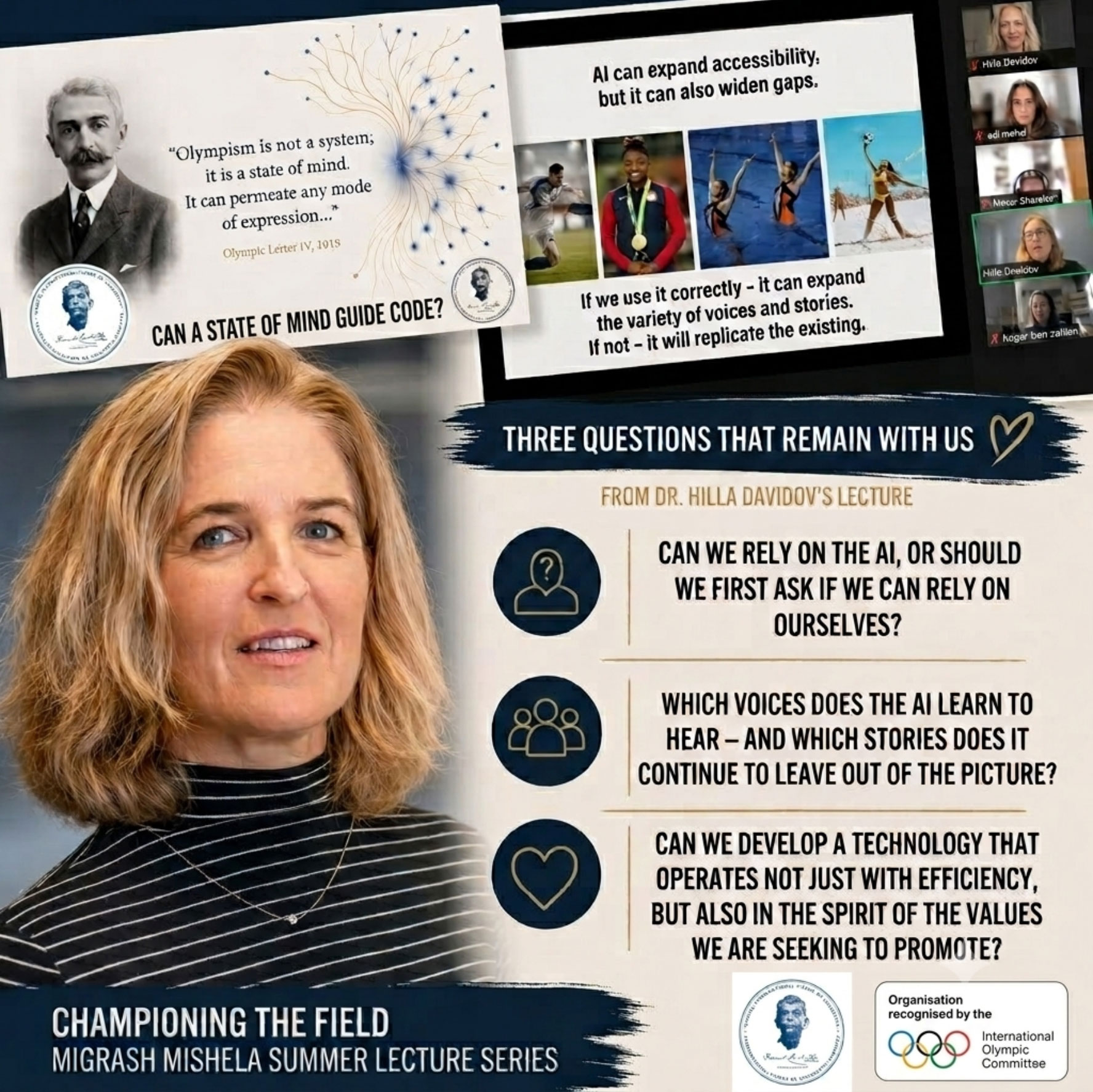
As part of the summer lecture series of “Researching the Field,” a thought-provoking lecture was delivered by Dr. Hilla Davidov, a Board Member of the International Pierre de Coubertin Committee, who explored a question that touches almost all of us:
Can artificial intelligence teach values?
The lecture was inspired by the idea of Olympism, a philosophy that views sport as a means of human development through values such as respect, friendship, and excellence, and explored how these values can guide us in the age of artificial intelligence.
One of the central messages of the lecture was that perhaps the question is not whether we can trust AI, but whether we can trust ourselves.
We often talk about “biases in artificial intelligence”, but as Hilla emphasized, AI is not biased by itself, it learns from the world we have created. If women have historically received less representation in the media, research, or educational materials, AI systems may learn these patterns and reproduce them.
The example she presented was simple yet powerful: a request to generate an image of a “football player” automatically produced an image of a man. Only when the question was changed to “Why not a female football player?” did the system explain that it was relying on existing patterns of representation. In other words, it was not the technology that made the choice, it was the human reality from which it learned.
The implication for us, as coaches, educators, teachers, and professionals in education, is not to avoid using artificial intelligence, but rather to use it critically. We must ask questions, challenge assumptions, verify sources, and consider which voices may be missing.
AI can be used to introduce students to the stories of female athletes who have been overlooked in educational materials, create more diverse content, and expand perspectives, but only when guided by human judgment.
Perhaps the most important insight of the evening was this: the more powerful technology becomes, the stronger the need for human presence becomes. Artificial intelligence can accelerate processes, but it cannot replace empathy, dialogue, judgment, and critical thinking.
Ultimately, AI does not only reveal our technological capabilities, it also reveals our values, assumptions, and biases.
The International Pierre de Coubertin Committee expresses its appreciation to Dr. Hilla Davidov for this inspiring lecture and for her continued efforts to promote and advance the values of Olympism through education, research, and dialogue.
Her work highlights the ongoing relevance of Coubertin’s vision in a rapidly changing world, reminding us that even in the digital age, fair play begins with human beings.